
Federal Release Paths
No Bureau of Prisons-operated prison was identified in Bell County. A person linked to Bell County may be held elsewhere after a federal arrest, transported under the U.S. Marshals Service, placed in a contracted state or local bed, and later designated to a BOP institution. County of arrest therefore does not reveal the facility of release.
A person can leave BOP confinement through sentence completion, court-ordered release, or a community corrections placement. Another person can leave one federal custodian only to enter state, local, or immigration custody. The BOP Inmate Locator is the durable public route once a person has a BOP record. For pretrial movement, the federal docket, counsel, detention facility, and responsible Marshals district are more useful.
Confirm a Federal Release
Search the BOP locator by register number when known. It also accepts DCDC, FBI, or INS numbers. A name search can use age, race, and sex filters to separate similar results. Match the identifier and personal details before reading status. Results can display name, register number, age, race, sex, release date, and location.
- Record the exact status, location, register number, and release-date label.
- Read the BOP result guide before interpreting unusual terms.
- Check the Eastern District of Kentucky docket for the detention or release order in a Bell County-connected case.
- Confirm actual processing with the facility or appropriate federal custodian.
- If another sovereign may hold the person, continue with that agency's locator.
A past date paired with “Released” or “Not in BOP Custody” supports the conclusion that BOP custody ended on that date. It does not establish freedom from every agency. The Bell County released inmate search provides the county and Kentucky corrections branches when the federal result points elsewhere.
Federal Release Record Sources
The BOP locator is a nationwide search service rather than a Bell County facility. Its public result is the first record source for a former sentenced federal prisoner. A federal court docket supplies legal authority, orders, judgment, and later case action. The Marshals Service holds federal defendants from court-ordered detention until release or acquittal, or until transfer after conviction, but its Prisoner Tracking System is not a public name locator.
BOP Inmate Locator: nationwide prisoner search
Eastern District of Kentucky: court docket and orders
U.S. Marshals Service: detention movement and FOIA
National Archives: selected older federal records
For an existing Marshals custody or disposition record, use the USMS prisoner information gateway and its FOIA route. For the court case, use PACER or CM/ECF through the Eastern District of Kentucky. Ask for a named existing record and include the full name, case number, register number, date range, and facility when known.
About the Federal Locator
BOP's web coverage is principally 1982 forward, with some older records. Earlier records may require the National Archives. The locator covers the federal prison record universe. It is not the Bell County jail roster, KOOL, the Marshals' internal tracking system, or the ICE locator.
A Bell County criminal event does not guarantee federal custody. Local charges remain in Bell County court and detention systems. Kentucky felony imprisonment belongs to KDOC. Federal charges proceed in federal court, and sentenced prisoners may be designated far from Kentucky. Search by custodian and identifier, not merely by the place connected to the case.
Read Federal Status Terms
“UNKNOWN” means the confinement term has not been determined. It should not be restated as an unknown past release. “In Transit” describes movement within the federal process, not release to the community. A Community Corrections Management location remains part of a BOP placement context, even when the person is not inside a conventional prison.
A future release date is projected and can change, including after sentence-credit recalculation or later court action. A past date is historical only when the status supports that reading. Preserve the result's exact words. Do not replace a qualified BOP phrase with a broader claim that the person is free.
Bell County Federal Docket Check
The federal docket can show whether a judge ordered detention, release, acquittal, sentence, or another case action. It may also identify counsel and the agency involved. Yet an order is legal authority, not proof of the exact minute the detention facility completed processing. A different warrant, detainer, or sovereign can affect the movement.
For a pending federal defendant, search the Eastern District docket by case number or party name and read orders in sequence. Contact counsel or the responsible detention route when timing matters. The Marshals Service has no broad public prisoner roster comparable to KOOL or the BOP locator.
From Federal to Other Custody
“Not in BOP custody” can mean a completed federal release, but it can also coexist with USMS, state, local, or immigration custody. If Bell County Detention Center recorded a federal pickup, ask whether the existing movement record identifies the receiving agency. Then use that agency's channel.
Use Federal and Immigration Release for ICE and Marshals distinctions. Use KOOL for Kentucky state imprisonment and the detention-center page for a Bell County booking. A chain of source-specific records is stronger than a conclusion drawn from one missing name.
Federal Release Records Before 1982
The BOP locator's principal online coverage begins in 1982. A failed search for an older federal prisoner should not be treated as proof that no record exists. The National Archives may hold records for earlier federal confinement. Start with every known identifier, including full name, birth details, register number, court, conviction date, and institution. Those facts help an archivist distinguish people with similar names.
Older federal records can be distributed among the sentencing court, BOP, USMS, and archival holdings. The judgment shows the sentence imposed. Prison records show institutional custody and release processing. A docket may contain later orders or corrections. Ask each custodian for an existing named document rather than a new narrative about the person's history.
For post-1982 records, a name search can still fail because of spelling, changed names, or incorrect filters. Try the register number first when it is available. If using a name, begin broadly and compare age, race, sex, and other displayed fields. Do not force a match merely because the person has a Bell County connection. The federal prison could be anywhere in the country.
A locator release date should also be reconciled with later custody. A completed BOP term does not erase a state warrant, immigration action, or new case. If the federal docket identifies an order but BOP still shows a different status, preserve both sources and ask the relevant custodian for clarification. Data timing, sentence calculation, and physical processing can produce short differences.
The official BOP search screen is shown below as the nationwide entry point.
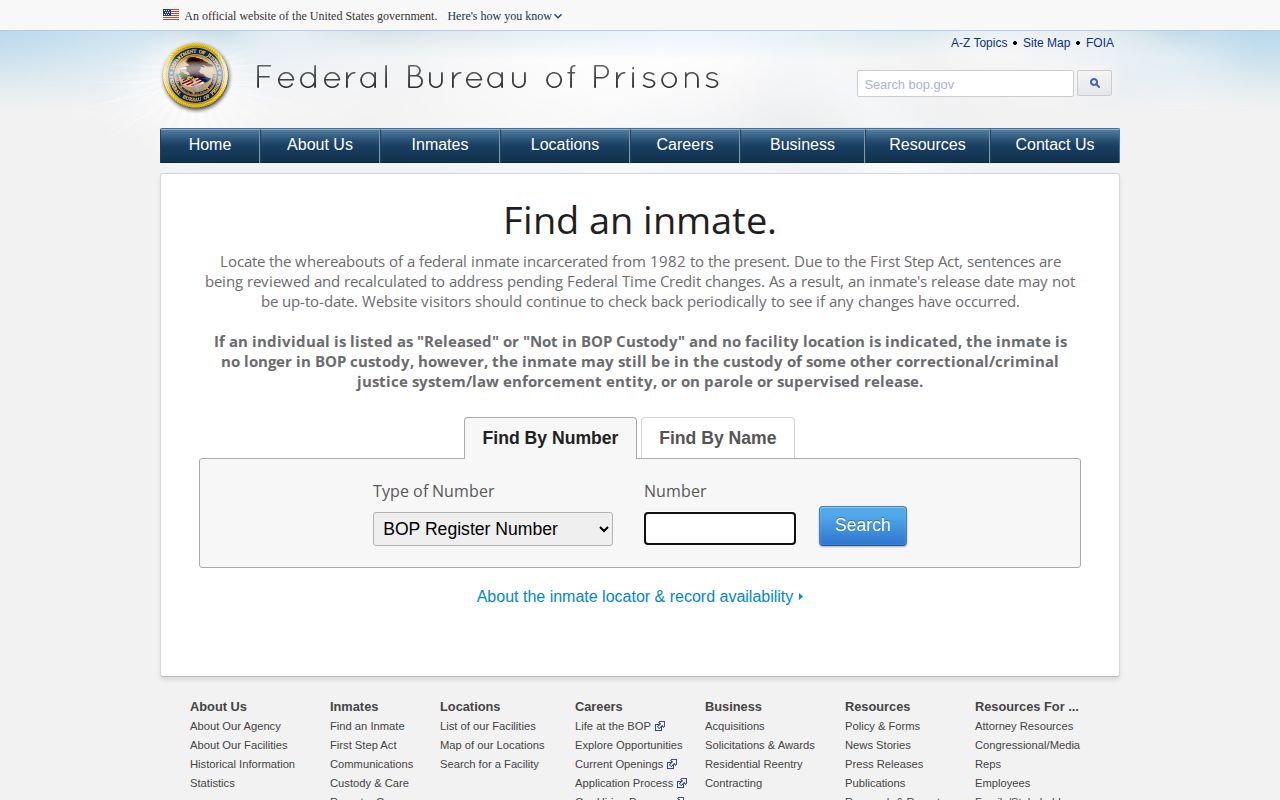
The screen supports identifier and biographical routes, but the result vocabulary and custody chain determine what a displayed date means for a Bell County-connected person.
Match Bell County Federal Identity
Federal identifiers are the safest way to separate similar names. A BOP register number belongs to the federal prison record. An FBI, DCDC, or INS number may also support an identifier search. A federal court case number belongs to the docket. Bell County's local booking number belongs only to the county jail episode. Preserve each number with its source instead of treating them as interchangeable.
When only a name is known, search broadly and compare every available field. Age, race, sex, conviction details, aliases, and court context can help confirm a result. A shared name or connection to southeastern Kentucky is not enough. If the BOP result and federal docket appear to concern different people, stop and obtain a stronger identifier from the court file or an existing custody record.
The date sequence also matters. A USMS pretrial event can precede BOP designation. After conviction, the Marshals Service may transport the prisoner before a BOP institution appears. At the end of BOP custody, another sovereign can take custody. Write down the agency, status, location, and date at each step. That sequence makes “In Transit,” a community corrections location, and “Released” much easier to interpret.
For documentary proof, request the specific federal record needed. A judgment and commitment order shows the sentence. A docketed release order shows court authority. BOP records show prison custody and release processing. USMS records can document federal detention movement. Older archival holdings may fill a gap outside the locator's main date range. No single document should be stretched beyond the event it records.
Federal Release Date Changes
A future BOP date remains projected. Sentence-credit recalculation, later court action, or a corrected record can change it. Save the result date and check again near the expected event. After the date passes, look for the matching released status rather than assuming the projection became final.
If the locator still shows an institution or community corrections location, read that displayed placement literally. Confirming the end of BOP custody requires the completed status and date, while confirming freedom from all custody requires checking any known state, local, or immigration hold.